
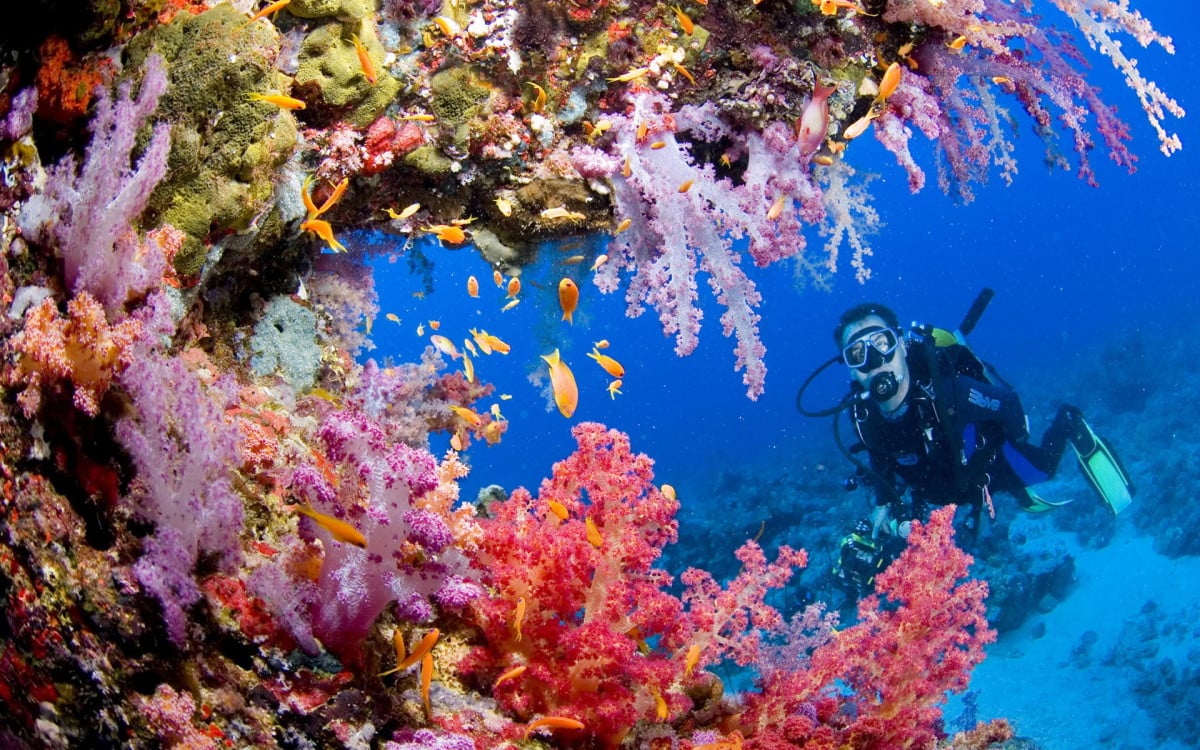
TTubbataha Reef is an atoll coral reef located in the Sulu Sea of the Philippines. It is a marine sanctuary protected as Tubbataha Reef National Marine Park. It is nominated at the New 7 Wonders of Nature.The word tubbataha is a combination of two Samal words: tubba and taha, which together means “a long reef exposed at low tide”.
Tubbataha is located in the Sulu Sea, 98 nautical miles (181 km) southeast of Puerto Princesa City in the Palawan Province. The reef is made up of two coral atolls divided by an eight-kilometer (5 miles) wide channel. The South Atoll, the smaller of the two is five kilometers in length and three kilometers in width; while the North Atoll, the larger of the two is 16 kilometers (9.9 mi) long and five kilometers (3 miles) wide.(Knipp 22) Each reef has a single small islet that protrudes from the water. The atolls are separated by a deep channel 8 km (5.0 mi) wide.
There are no permanent inhabitants of the islets or reefs. Fishermen visit the area seasonally, establishing shelters on the islets. The park is visited by tourists, particularly divers. Trips to Tubbattaha from mid-March to mid-June are all vessel-based; the park is about twelve hours by boat from Puerto Princesa City. Tubbataha is considered as the best dive site in the Philippines and the diving dedicated ships that operate during the “Tubbataha Season” are usually booked years in advance especially during the Asian holidays of Easter and “Golden Week”.
Tubbataha has become a popular site for seasoned sports divers because of its coral “walls” where the shallow coral reef abruptly ends giving way to great depths. These “walls” are not only wonderful diving spots but they are also wonderful habitats for many colonies of fish. There are giant trevally (jacks), hammerhead sharks, barracudas, manta rays, palm-sized Moorish idols, napoleon wrasse, parrotfish, and moray eels living in the sanctuary. There also have been reported sightings of whale sharks and tiger sharks. Tubbataha is even home to the hawksbill sea turtles (Eretmochelys imbricata) which are endangered species. (Knipp 24)
Over 1000 species inhabit in the reef; many are already considered as endangered. Animal species found include manta rays, lionfish, sea turtles, clownfish, and sharks.
Vivid corals cover more than two-thirds of the area and the waters around the reef are places of refuge for numerous marine lives. The seemingly diverse ecosystem of this sanctuary rivals the Great Barrier Reef – having 350 coral species and 500 fish species. (Knipp 22, 24) In June 2009 an outbreak of the crown-of-thorns starfish was observed, possibly affecting the ecological functioning of this relatively pristine coral reef. [1]
Aside from being a marine sanctuary, Tubbataha is also renowned for being a bird sanctuary. A lighthouse islet, at the southern tip of the South Atoll, supports a large number of seabirds which nest there. Around the Tubbataha, there are tens of thousands of masked red-foot boobies, terns, and frigate birds resting during their annual migrations. To minimize any external intrusions, the Philippine Coast Guard maintains a small monitoring station on one of the many permanent sand bars.(Knipp 24)
The Tubbataha National Marine Park, located at the Central Sulu Sea, is a marine sanctuary containing a reef of enormous size. It was established on August 11, 1988 with an area of 332 km² (82,000 acres). In 2006, President Gloria Macapagal Arroyo, through an Executive Order, increased the boundaries of the park by 200%. It is now 968.24 km² (239,000 acres) in size and is guarded by armed rangers 24 hours/ 7 days a week.
Declared a World Heritage Site by the United Nations Educational, Scientific, and Cultural Organization (UNESCO) in December 1993, it is under protective management by the Philippines Department of National Defense (DND). It is under technical supervision by the Palawan Council for Sustainable Development (PCSD) & the Department of Environment & Natural Resources (DENR). It is administered as part of Cagayancillo town on Palawan. It is also nominated in the new 7 wonders of nature.
The Tubbataha National Marine Park is open to live-aboard diving excursions between the months of April to June. It is in this period where the waves are most calm. As of March 2011, the park entrance fee is pegged at USD $75.00 or PHP 3,000.00. Due to global warming, it is advised that divers book their trips towards the middle or end of April as the waves are still strong and may cause problems for dive excursions and underwater visibility.
Almost all current threats are low to very low but vigilance is needed to maintain these threats at a low level. Potential threats, mainly related to climate change, are mostly beyond the control of Park managers and the Philippines but are considered to be high if they occur.
Although the sand bars around Tubbataha are considered off limits to human beings, tourists are allowed to set foot at the Ranger Station where they can purchase souvenirs and tour the facility.
Best way to have an island hopping going back to Cebu
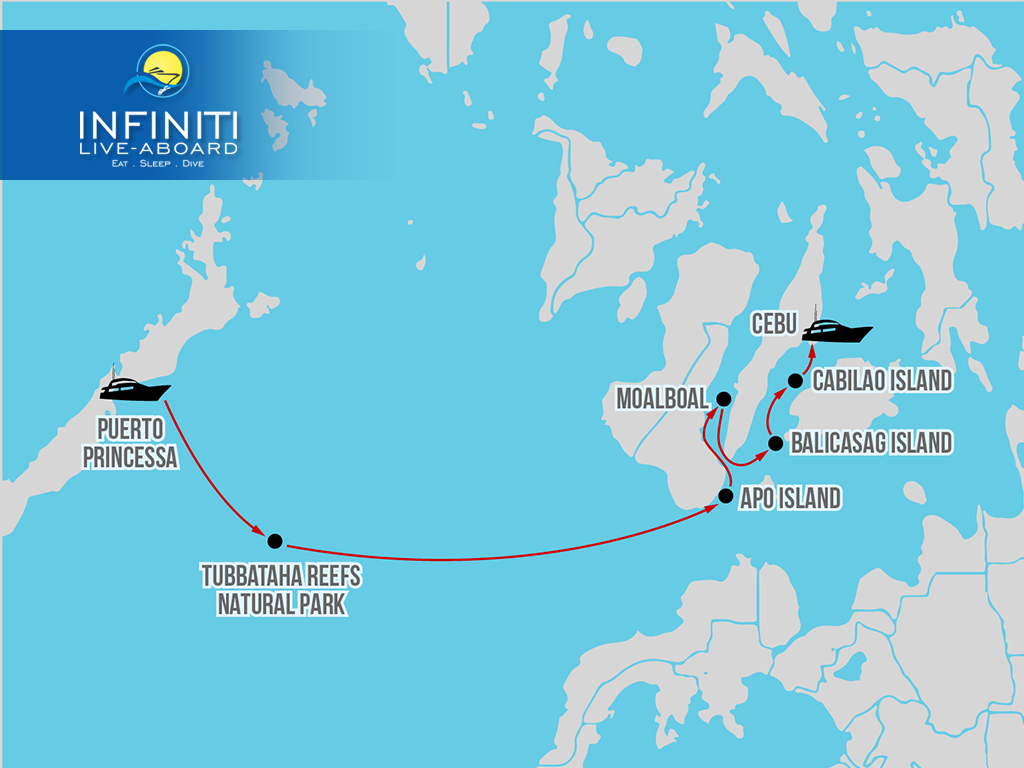
Departure Port: Puerto Princessa
Return Port: Cebu
Duration: 12 Days 11 Nights
Experience Level: Open water certified-20 min logged dives required
Our Guide will pick you up from the airport or your hotel and bring you to the Infiniti, where after a brief welcome and safety briefing, you will be assigned cabins. The cruise director will have a full schedule of dives and excursions ready for you.
This final dive trip of the Tubbataha Reef dive season is a transition trip where after exploring the Tubbataha Reefs Natural Park we sail off towards the Visayas Archipelago and disembarks in Cebu after exploring Visayas and Bohol.
Dive Sites
Located in the Sulu Sea, and about half a day’s boat ride from any major town, Tubbataha Reefs Natural Park is one of Asia’s best diving spots. Tubbataha reef is made of two coral Atolls-The North Atoll and the South Atoll.
With over 600 species of fish and 300 species of corals, nesting turtles, dozen species of sharks and dolphins, it offers a vastly biodiverse diving experience! The dive sites visited on this trip include and are not limited to the Malayan wreck, Wall Street, Amos rock, shark Airport, Washing Machine and the ranger station on the North Atoll. On the South Atoll, we will visit South West Wall, Staghorn Point, Delsan Wreck, Black Wreck and T wreck.
Apo Island Reef: Sailing through the Sulu Sea, we reach the Apo Island Reef to explore its beautiful coral gardens and marine life.
Moalboal and Pescador: We go on to explore Moalboal with its shoals of shimmering sardines and sea snakes, and Pescador Island with its shadow reef teeming with triggerfish, schools of snapper, turtles and macrolife .
Balicasag: On the final leg of this incredible journey, Balicasag in Bohol, a marine sanctuary where beautiful corals are teeming with reef life is great place for snorkeling and drift dives.
Cabilao Island: With its Barracudas, dogtooth tunas, giant trevallies and also macro marine life like sea horses and nudis make up for a memorable diving experience!
Please Note: This is a sample itinerary and our cruise director can modify the route according to the weather, currents and diving conditions. We wish to give you the best diving experience of the region, but safety of all on board is the foremost concern and we will do our best to offer alternate locations in case any of the listed sites is not accessible at the time.
 Aventurier